

What to Fix Before the End of Q2
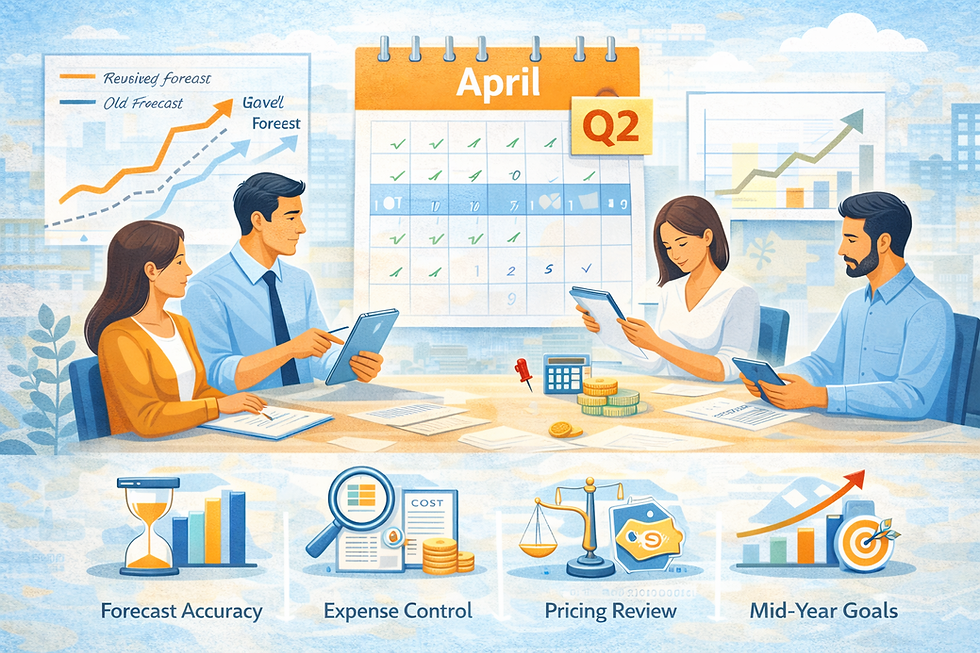
By April, businesses have enough financial data to evaluate whether the year is unfolding as planned. The first quarter reveals patterns that are often hidden during annual planning sessions. Revenue trends become clearer, expense increases start showing up in the financials, and operational challenges begin affecting profitability. Waiting until the second half of the year to address these issues can make corrections more difficult and more expensive.
Economic conditions in 2026 continue to create challenges for business owners. While inflation has moderated from its peak, many businesses are still dealing with elevated labor costs, higher insurance premiums, and borrowing costs that remain above pre-2022 levels. According to Federal Reserve economic data, businesses continue operating in an environment where margin pressure and liquidity management remain key concerns. This makes the end of Q2 an important checkpoint for evaluating financial performance and making adjustments before small problems become larger ones.
One of the first areas to review is financial forecasting. Many businesses enter the year with revenue targets and expense assumptions that are based on best-case expectations. Actual performance often tells a different story. Comparing year-to-date results against original forecasts helps identify whether growth projections remain realistic. If revenue is trailing expectations, adjusting forecasts now provides a more accurate foundation for hiring, capital expenditures, and cash flow planning. If revenue exceeds projections, updated forecasts can help determine whether additional investment or expansion opportunities are justified.
Cash flow forecasting remains one of the most important financial management tools in 2026. Revenue growth alone does not guarantee liquidity. According to recent small business financial studies, many profitable companies continue experiencing cash flow pressure because customer payment timing, debt obligations, and operating expenses create gaps between profitability and available cash. Reviewing a rolling twelve-month cash flow forecast before the end of Q2 provides visibility into upcoming challenges and allows businesses to address potential shortfalls before they impact operations.
Expense management deserves equal attention. Cost increases rarely occur all at once. They accumulate gradually through vendor price adjustments, subscription renewals, payroll growth, insurance increases, and operational inefficiencies. By the middle of the year, these expenses can significantly impact profitability if they are not reviewed regularly. Current finance discussions around capital efficiency and margin optimization emphasize the importance of evaluating expenses based on return rather than simply reducing spending. Businesses that identify low-value expenditures and redirect resources toward higher-impact activities often improve profitability without sacrificing growth.
Pricing strategy is another area that should be reviewed before the second half of the year. Many businesses adjusted pricing over the past several years in response to inflation and rising operating costs. However, costs have continued changing in 2026, and pricing structures that were effective twelve months ago may no longer support desired margins. Reviewing gross profit by service line, product category, or customer segment can reveal whether pricing remains aligned with actual delivery costs. Businesses that conduct regular pricing reviews are generally better positioned to protect profitability during periods of economic uncertainty.
Accounts receivable performance should also be evaluated before entering Q3. Slower customer payments can create significant pressure on working capital, particularly as consumer and business debt levels remain elevated. Reviewing average collection periods, outstanding invoices, and payment trends can help identify whether cash flow issues stem from revenue generation or collection efficiency. Improving receivables management often provides faster financial benefits than attempting to generate additional sales.
Operational performance often becomes easier to evaluate after a full quarter of activity. Growth may reveal inefficiencies that were not obvious at lower volumes. Manual processes, communication bottlenecks, and inconsistent workflows frequently become more expensive as businesses expand. Reviewing operational metrics alongside financial results helps identify whether profitability challenges stem from cost issues, process inefficiencies, or resource allocation problems. Businesses that improve operational efficiency often strengthen margins without increasing prices or reducing service quality.
The end of Q2 also provides an opportunity to evaluate broader financial goals. Business owners planning to seek financing, expand operations, hire additional employees, or invest in new technology should review balance sheet strength, debt levels, and retained earnings growth. Lenders continue emphasizing liquidity, debt service coverage ratios, and financial reporting quality when evaluating financing requests. Addressing weaknesses before opportunities arise creates greater flexibility later in the year.
Businesses rarely lose momentum because of a single major mistake. More often, performance drifts gradually as forecasts become outdated, expenses increase unnoticed, and operational inefficiencies accumulate. Reviewing financial performance before the end of Q2 provides an opportunity to correct course while there is still ample time to influence year-end results. Accurate forecasting, disciplined expense management, strategic pricing reviews, and strong cash flow visibility help ensure that growth plans remain supported by financial reality.


Comments