

2026 Interest Rate Outlook and How Small Businesses Should Adjust Debt Strategy
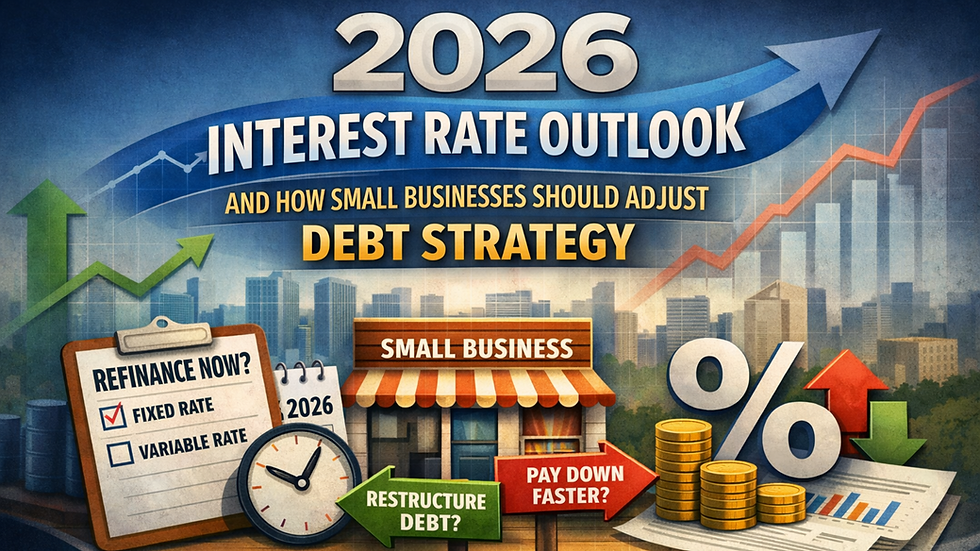
The 2026 interest rate outlook for small businesses is still shaped by volatility from the past few years. Rates are no longer at emergency highs, but they are far from the ultra-low environment many business owners grew used to in the early 2020s. The Federal Reserve continues signaling a data-driven approach, which means interest rate shifts are still possible throughout the year.
For small business owners, the question is not where rates will move next. The real question is how to adjust your debt strategy now so your business stays protected regardless of what happens.
What the 2026 Interest Rate Outlook Means for Borrowing
As of early 2026, benchmark rates remain elevated compared to pre-2022 levels. Commercial loan rates reflect tighter credit conditions, and lenders are scrutinizing liquidity and debt service coverage ratios more closely.
If you have a variable rate loan, line of credit tied to prime, or short-term financing, even a small rate increase can impact monthly payments. That makes it critical to understand how your current debt structure performs under different rate scenarios.
Cash flow forecasting in 2026 is no longer optional. It is the foundation of responsible borrowing.
Should You Refinance Your Business Loan in 2026?
Many owners are asking whether it makes sense to refinance a business loan in 2026. The answer depends on structure, not headlines.
Before refinancing, evaluate:
Your current effective interest rate
Remaining loan term
Prepayment penalties
Available fixed rate options
Closing and restructuring costs
If you can lock in predictable payments without draining liquidity, refinancing may reduce long-term risk. But if the fees outweigh the benefit, holding your current structure could make more sense.
The key is running projections. Compare your existing loan against a refinance option using a 12-month cash flow forecast. Numbers clarify what emotion cannot.
Fixed vs Variable Rate Loans in 2026
The fixed vs variable rate loan debate is really about stability.
Businesses with consistent revenue and strong margins may tolerate variable rate exposure if forecasts show sufficient buffer. Companies with seasonal revenue or tighter margins often benefit from fixed payments, even if the rate is slightly higher.
In the current 2026 interest rate outlook, predictability has value. Stable payments allow clearer planning around hiring, inventory, and capital investments.
If volatility keeps you up at night, that is a signal worth listening to.
Accelerate Debt Repayment or Preserve Liquidity?
Another common question in small business debt strategy is whether to pay down principal faster or preserve cash.
Accelerating repayment lowers interest expense and strengthens your balance sheet. It improves leverage ratios and may increase future borrowing power.
However, draining working capital to eliminate debt can restrict growth. Liquidity creates flexibility. A healthy cash reserve can fund marketing, hiring, equipment, or unexpected opportunities.
Before accelerating payments, review:
Debt service coverage ratio
Net leverage position
12-month rolling cash flow forecast
Opportunity cost of using cash for repayment
In some cases, restructuring debt into a longer amortization schedule may provide breathing room without sacrificing long-term goals.
Building a Smarter Debt Strategy for 2026
The smartest small businesses in 2026 are not guessing. They are modeling.
A proactive debt strategy includes:
Stress testing loans against rate increases
Reviewing loan covenants regularly
Evaluating refinance windows quarterly
Aligning debt maturity with revenue stability
The 2026 interest rate outlook for small businesses does not promise ultra-cheap capital. It demands discipline.
Businesses that structure debt intentionally, forecast cash flow consistently, and protect liquidity position themselves for stable growth even if rates fluctuate again.
Interest rates in 2026 remain higher than many small businesses would prefer. That reality does not prevent growth. It simply requires smarter debt decisions.
If you evaluate refinancing carefully, choose the right balance between fixed and variable exposure, and protect liquidity while managing repayment, your capital structure becomes an asset rather than a liability.
Uncertainty will remain part of the economy. A disciplined debt strategy ensures it does not control your business.


Comments